
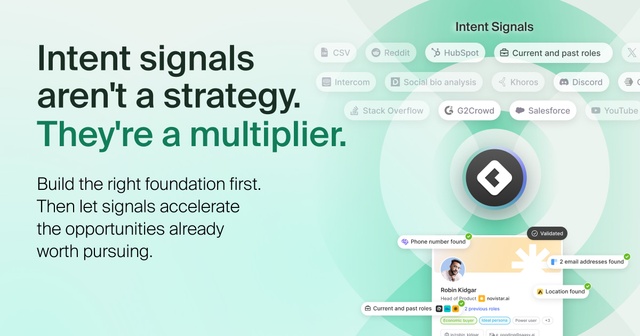

Everyone is obsessed with intent signals right now.
And honestly, fair. The technology has gotten genuinely good. You can see which accounts are visiting your website, reading your competitors' reviews, downloading content about problems you solve, and quietly researching solutions at 11pm on a Tuesday.
That's remarkable. A few years ago you couldn't see any of it.
The problem is what happens next.
Most teams treat intent signals like a metal detector on a beach. Something beeps, they start digging. Another beep, more digging. By the end of the day they've dug a hundred holes and found a lot of bottle caps.
Intent signals without a foundation aren't targeting. They're just expensive activity.
The seductive lie of a hot signal
Here's how it usually goes.
A company invests in an intent data tool. The dashboard lights up with accounts showing buying signals. Reps get excited. Pipeline reviews get more interesting. Someone in leadership calls it a game changer.
Six months later, conversion rates haven't moved. Reps are frustrated because they're chasing signals that go nowhere. The intent tool quietly becomes shelfware.
What went wrong isn't the signals. The signals were real. What went wrong is that the team was using signals to decide who to target instead of when to reach out to accounts they'd already decided were worth targeting.
Those are two completely different jobs. And intent signals are only built for one of them.
A developer platform I've spoken with recently had exactly this problem. Their scoring was built on self-serve usage data - great for their PLG motion, but completely blind to the top-down buying happening at companies before their first product touchpoint. They had intent signals firing on accounts that looked active but didn't fit. And they were missing accounts that fit perfectly but hadn't shown up in their product yet.
More signals, more noise, same pipeline problem.
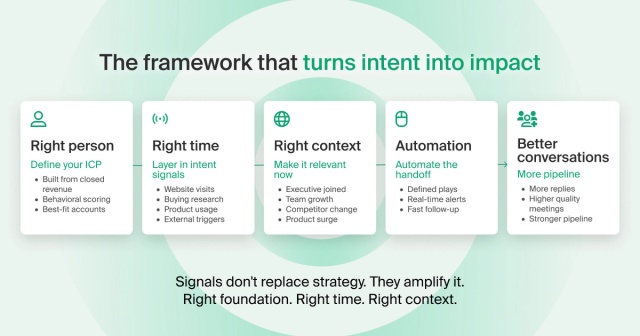
Right person, right time, right context - in that order
Here's the reframe that changes everything.
Intent signals don't tell you who deserves your attention. They tell you when to give it.
The sequence matters enormously.
First you define the who - the ICP built from your actual closed revenue, the behavioral profile of accounts that converted, the organizational patterns that show up in your best deals. That's your foundation. It's relatively stable. It doesn't change because an account visited your pricing page.
Then you layer in timing - the intent signals, the product behaviors, the external triggers that tell you this account is active right now. That's your accelerant. It tells you which accounts on your list are worth prioritizing this week vs. next quarter.
And then comes context - what's actually happening in this account that makes your outreach relevant right now? An executive just signed up. A team just surged. A competitor just had a bad quarter. That's what transforms a sequence into a conversation.
Right person. Right time. Right context.
Skip the first step and you're doing expensive prospecting with better technology. Nail all three and you're not interrupting anyone - you're showing up exactly when they need you.
The hierarchy that makes it work
The teams getting the most out of intent signals have built a clear hierarchy for how they act on them.
Otter AI operationalized this directly. High signal plus high fit - a human reviews before anything goes out. Strong signal and medium fit - full automation. Low signal or low fit - ignore or low-touch nurture. No signal - no action.
That last one is the hardest discipline to maintain. No action. Not a nurture sequence. Not a "just checking in." Nothing.
Because acting on weak signals doesn't just waste rep time - it trains your market to ignore you. Every irrelevant outreach makes the relevant ones harder to land.
The hierarchy isn't just a prioritization model. It's a commitment to only reaching out when you actually have something worth saying. Which, in a world drowning in AI-generated sequences, is becoming a genuine competitive advantage.
The gap that actually costs pipeline
Here's the thing that keeps coming up in conversations with go-to-market leaders: the biggest pipeline problem usually isn't bad targeting. It's the gap between when a signal fires and when someone acts on it.
A signal fires Tuesday. By Thursday it's buried. By the following week the account has moved on.
One team ran a four-week pilot focused entirely on closing this gap - surfacing signals to reps the moment they appeared, with the play already defined so there was no ambiguity about what to do next. The result was $1.6M in influenced pipeline from accounts that had been slipping through for months.
The accounts were always there. The signals were always firing.
The gap was operational. Nobody was built to act fast enough.
Intent signals are only as powerful as the infrastructure underneath them. The ICP work tells you who. The signal tells you when. The automation closes the gap between when the signal fires and when the motion runs.
Take any one of those three out and the other two don't work.
What this means for how you invest
If you're evaluating intent tools right now - or wondering why the ones you have aren't converting - the question to ask first isn't which signals are best.
It's whether your foundation is solid enough for signals to land on.
Have you done the win-loss analysis that tells you what your real enterprise ICP looks like? Have you built a behavioral scoring model that weights product signals over demographic fit? Have you defined the plays that run when a signal fires?
If not, more intent data won't fix it. You'll just have a more expensive dashboard full of bottle caps.
Build the foundation first. Then the signals become what they're actually meant to be - not a strategy, but a multiplier.
Next in the series: the automation architecture that ties it all together - how to wire signal to sequence without building something nobody can maintain.