
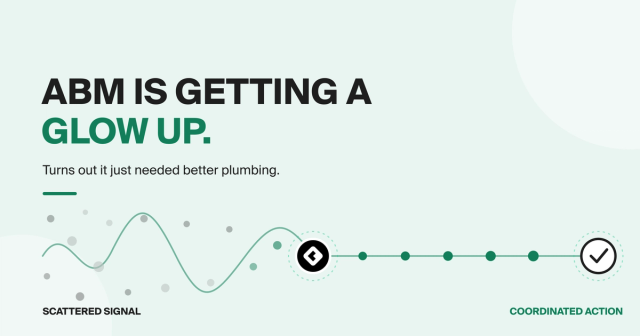

A signal you don't act on isn't a signal. It's just a notification you'll swipe past tomorrow.
Meet Scranton Analytics. Not a real company, but you've worked one just like it: a buying committee of six people who don't talk to each other, which means you don't either.
Procurement's been quietly hitting your pricing page every other day. The champion who loved you in the demo has gone dark. Your AE is chasing the CFO. Your SDR is chasing someone in IT who left the company two months ago, and nobody updated the record.
Everyone at Scranton Analytics is doing something. Nobody's doing it on the same page.
How “bad data” became the industry scapegoat
Most ABM programs have a sequencing problem, and it's not the one people complain about in QBRs.
Everyone blames the data. Bad data, stale data, data that lives in four systems and agrees with none of them, like siblings describing the same childhood. But look closer at Scranton Analytics and the data isn't even wrong. The champion really did go dark. Procurement really is on the pricing page. Every fact any single rep is holding is true. But nobody's holding it up against anyone else's version.
That's the real bad data problem: not incorrect information, just correct information that never got compared to itself. And there's an even quieter problem underneath that: because even when the data is good, someone still has to translate it into action.
That's the signal. Everyone agrees it's a good one. And then someone, somewhere, has to actually do something with it. Tell the gifting platform. Update the ad audience. Loop in the field rep. Make sure marketing knows what sales already knows, and vice versa, which somehow never happens on schedule.
That translation step is where ABM quietly falls apart. Not because anyone's slow or careless. But because manual translation is inconsistent by definition, and inconsistent doesn't scale. Scranton Analytics' signal fires on a Tuesday. By the time it becomes an action, it's Thursday, and Scranton Analytics already took a call from your competitor.
The fix isn't a better notification. Notifications are just guilt with a timestamp. The fix is removing the translation layer entirely.
What "coordinated" actually looks like, versus what everyone calls coordinated
The dream of ABM has always been coordination: sales and marketing working the same accounts off the same intelligence, at the same time, without a Slack thread or a standing meeting holding it together.
The reality for Scranton Analytics and every account like it has usually fallen short. Sales knows Scranton Analytics hit the pricing page three times. Marketing finds out at the next pipeline review, if it comes up at all. The gift ships two weeks after the deal already closed, at which point sending a company a crate of beets feels less like a gesture and more like an apology nobody asked for. The ad keeps chasing Scranton Analytics for another month after they signed, which is its own special kind of awkward.
Nobody intended any of this. It's just what happens when the signal and the action live in different systems, and coordination becomes a task instead of a byproduct. Human effort doesn't scale, which is why most ABM programs look coordinated in the slide deck and feel like a relay race where the baton keeps hitting the ground.
When the signal drives everything, instead of just informing everything
Now run Scranton Analytics through the version that actually works.
The Sendoso integration changes what happens the moment Scranton Analytics qualifies in Common Room. Not a notification. Not a record update sitting in someone's queue. A gift ships because the signal fired, full stop, no one had to tell the gifting platform a thing.
Scranton Analytics enters the high intent segment on a Tuesday morning. Common Room triggers the Sendoso workflow directly, and a package is already on its way before the rep has finished their coffee. The outreach follows. Signal and action happen in the same motion, from the same data, with zero humans standing in the middle playing a very expensive game of telephone.
That's not automation for its own sake. That's what coordination looks like when it's built into the system instead of aspired to in the org chart. The rep knows the gift shipped. Marketing knows Scranton Analytics is in motion. The ad targeting reflects the exact signal that triggered the gift. Same account, same intelligence, same moment, not because two teams synced up, but because they never had to.
The LinkedIn Ads integration runs on the same logic. Scranton Analytics qualifies, the ad audience updates, and Scranton Analytics starts seeing Common Room ads without anyone exporting a CSV and uploading it like it's 2016. The same signal telling sales to reach out is telling marketing to turn up the pressure. One signal, two motions, zero syncing, and nobody sends Scranton Analytics a crate of beets after they've already signed.
The black box problem, and why explainability is the actual product
There's a version of intent based marketing that's become the default, and it has one fatal flaw: nobody can explain what it's doing.
A score goes up. Scranton Analytics appears on a list. A campaign fires. Ask why, and the honest answer is usually "the model decided," a sentence that has never once made a sales rep feel better about anything, ever, in the history of sales reps.
Common Room runs the opposite direction. Every signal is traceable. Every trigger is explainable. When Scranton Analytics' gift ships or the ad audience updates, it's because Scranton Analytics did a specific thing that crossed a specific threshold the team actually defined. The rep can see it. The manager can audit it. Marketing can tune it.
Explainable ABM isn't just more trustworthy, it's more useful. When the rep calls Scranton Analytics, they're not guessing why the account showed up on their list. They know exactly what Scranton Analytics did, which means they walk into a sharper conversation instead of a fishing expedition. And a sharper conversation is the entire point of doing any of this.
Coordination was never a people problem
ABM programs don't fragment because the people running them are bad at their jobs. They fragment because coordination is hard to sustain when it depends on manual handoffs between systems that were never designed to talk to each other.
Scranton Analytics didn't fall through the cracks because someone dropped the ball. Scranton Analytics fell through the cracks because the ball had to pass through six different hands to get anywhere, and six is a lot of hands.
The Sendoso and LinkedIn integrations aren't features that make Common Room "more connected," a phrase that belongs on a pitch deck slide nobody remembers by Q3. They're the answer to a structural problem: when one intelligence layer drives every downstream action at once, the translation step disappears. Sales and marketing stop coordinating and start running off the same signal automatically, without a single status update between them.
ABM wasn't the problem. The plumbing was.
ABM earned its reputation the hard way. For years the technology couldn’t deliver its promise so everyone assumed it was the wrong strategy.
Every deck said coordinated, personalized, at scale. Every execution required six tools, three exports, and someone's entire Tuesday to make sure Scranton Analytics didn't get a crate of beets three weeks too late.
The strategy was never the issue. Work the accounts that matter, with the same intelligence, at the same time, across every channel. Nobody in the history of marketing has disagreed with that sentence. They just couldn't build it, because the systems holding the signal and the systems taking the action never talked to each other without a human relaying messages in between.
That intelligence exists now. The systems can talk to each other. Scranton Analytics' signal is the action, not a suggestion someone has to notice, interpret, and remember to act on before the account goes cold. Which means the thing ABM always claimed to be finally gets to be that thing, instead of the thing everyone quietly apologized for on the way into the meeting.
Same three letters. Just an actual strategy now, instead of a nasty one. Scranton Analytics, wherever you are, you deserved better plumbing this whole time.