
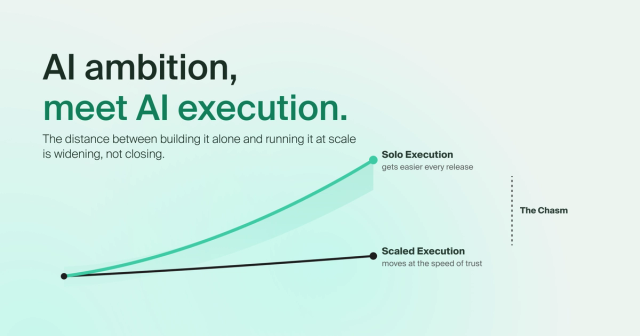

What was once a gap has now become a chasm. Because the distance between AI ambition and AI execution is quickly widening.
Every company has a point of view on AI now. Ask any exec and you'll get a fully formed opinion. Agents, copilots, "AI-native" somewhere in the header font. That part got easy. Today, a weekend and a Claude subscription buys anyone a working prototype. That used to be a differentiator. Now it's a Tuesday.
Building the prototype is the easy part. You wrote something, shipped something, proved it could work. But a working demo is not a working system. The moment you hand it to a second person, a different set of problems begins.
So if zero-to-one is execution, where's the actual chasm?
It's between two different kinds of execution: solo execution and scaled execution.
Solo execution: the easy kind
One person, one weekend, no handoffs, no organizational friction, no legacy process fighting back. You don't need buy-in. You don't need a rollout plan. You need an idea and enough stubbornness to sit with it until it works, plus a suspicious amount of caffeine.
That's not nothing. But it's the easy version of execution, and the bar for it just fell off a cliff. What used to take an engineering team a quarter now takes one motivated person a weekend and a browser tab. That was impressive six months ago, but it's table stakes today.
The mistake almost everyone makes is treating that moment, the demo, the prototype, the proof it can work, as the finish line. It's not. It's only the qualifying round. The real test is still ahead of you, and it's called Monday morning, when someone else has to use the thing.
Scaled execution: the hard kind
In comes from someone who didn't build it, someone with no reason to trust it yet, someone whose job doesn't change just because your demo worked, and who has heard "this will save you time" approximately eleven thousand times before.
This is usually the part of the story where trust is either won or lost, and it's usually lost. Because after you answer "Does it work?" you'll get asked an entirely different set of questions:
Does the workflow have real governance? Or does it only work because one person is holding it together with duct tape and goodwill, and everyone quietly knows not to ask what happens when that person takes a vacation?
Does it survive a rollout to a second team? Or does it stay a one-person trick that never leaves the room it was born in, like a magic act nobody else knows the moves to?
When the output lands on someone else's desk, do they use it? Or do they smile, say thanks, and quietly redo it by hand?
The last one is the most important tell, what I call the "redo-by-hand moment." It's what happens when someone receives an AI-generated output like a prioritized account list, a drafted email, or a research brief, decides they don't trust it, and silently fixes it themselves rather than saying something out loud.
This doesn't show up in a dashboard, and nobody puts it in the board deck. Because "we shipped an AI workflow and then everyone ignored it" doesn't make the highlight reel. It happens quietly, at a desk, and multiplies invisibly across the org.
Multiply that moment across a company and you have the entire chasm.
Why the gap is widening, not closing
The tools keep getting better, which is exactly why this is getting worse, not better. Nobody wants to hear that, so I'll say it twice.
Solo execution scales with the tools: better models, better agent frameworks, cheaper compute, all of it makes the weekend demo faster and more impressive. The capability curve is real and it is steep.
Scaled execution grows with something the tools can't touch: how fast an organization is willing to change how it works. That's not a technology variable, it's a human variable. Team structures still take quarters to shift. Trust between departments still has to be earned the slow, unglamorous way. Someone still has to be the first person to stop redoing the AI's work by hand and just believe it, and no model release has ever made that easier.
So the gap between what one human can prototype and what a company can actually run doesn't shrink as the tools improve. It grows. Every model release makes the demo more impressive and does exactly nothing for the org's ability to absorb it. You cannot prompt your way out of a trust problem.
What crossing the chasm actually requires
If scaled execution is the hard part, then the infrastructure underneath it matters more than the demo on top of it. And that infrastructure has to solve three real problems, not one.
Pipeline generation cannot happen in a functional silo.
Sales and marketing have to work the same accounts from the same intelligence. That means the signal that tells you an account is in motion has to be actionable for demand gen and marketing orgs, not just visible to a single rep. The gifting fires because the signal fired. The ad targets the account because the account is actually moving. No separate team translating insight into action by hand.
Scaling to teams requires more than a shared dashboard.
Buyer groups are complex. Manager visibility matters. The motions that actually move enterprise deals, multi-threading, coaching, pipeline accountability, have to be measurable, auditable, and coachable. Not a vanity report. A real system of action for how the team works accounts and effects outcomes.
For the teams building their own workflows, intelligence has to meet them where they already build.
That means every surface area becomes an intelligent copilot. Ask it a question in Slack and get an answer built on real signal. Wire it headless into your own agent stack. No separate UI required, just intelligence delivered where the work already happens.
That's the part of this we've been heads down on. Not another demo. The infrastructure, governance, and workflow flexibility that let ambition survive contact with an actual org.
The chasm is real. So is the infrastructure to cross it.
We're dropping proof of that this week...Common Room Slack Bot, headless agent intelligence superpowers, gifting, ads, buyer committee…
Want early access? Reach out.