

There's a version of AI adoption that looks like a win in the boardroom then dies at the desk.
Here's how it goes. A team builds something real like a prioritized account list, a research brief, or a signal that fires the second the right account hits the right page. The demo is clean. The workflow makes sense. Someone puts it in front of leadership and the slide gets a nod.
Then Monday happens. A rep opens Slack, and twelve things are already on fire. But the intelligence the rep needs is sitting in some other tab, or in some other platform, waiting to be leveraged. But the rep does not have the time to look for it, so they do what most people do: they work around it and pull the list themselves, skim LinkedIn real quick, and write that outbound email cold.
Nobody ever announces this, it just happens. Quietly, at every desk…every single day, until the AI workflow that was supposed to transform the team’s capabilities simply becomes another tab nobody opens.
I call it the re-do-by-hand moment, and it’s the real adoption problem. This has nothing to do with whether your intelligence is any good. In fact, it can be excellent. But that doesn’t matter because if it lives somewhere people have to go find it, half the team never will.
And the fix isn’t a better dashboard, the fix is deleting the dashboard from the equation entirely. Not redesigning it or adding some widget or scheduling a “let’s revisit our internal tools” meeting…Deleting it.
Where the work already happens
Ask any rep where they spend their day and you'll get an honest answer: Slack, email, a CRM tab that's been open since 8am. Nobody ever says "my GTM platform." Seriously, nobody has ever said that. But that list of tools isn’t permanent, it’s just today’s list. Because where the work happens keeps moving.
Six months ago half your reps weren’t running their day with the support of an AI assistant. Now they are, and in six more months that list of tools will look different again. So the real question was never "is it in Slack?" It's "does the intelligence show up wherever the work has decided to live this quarter" because it will keep deciding new places, on its own schedule, without asking marketing for a roadmap slot.
Intelligence in a separate system means a context switch, and context switches cost something. Make the cost high enough and the day full enough, and the switch just doesn't happen. The intelligence stays put, and the rep moves on without it. That’s why the teams that have meaningfully solved AI adoption have intelligence that shows up anywhere and everywhere the work already happens. And it keeps showing up even when “anywhere and everywhere” changes,
That's not a nice-to-have. That's the entire difference between intelligence that changes behavior and intelligence that sits in a report feeling good about itself.
What it looks like when it actually works
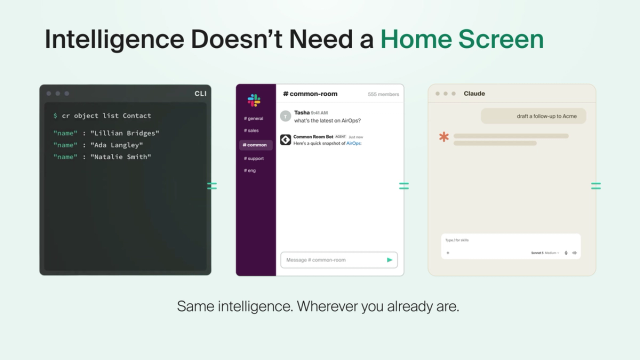
The Common Room Slack Bot runs on one premise: if a rep can ask a question about an account and get a real answer without leaving Slack, the intelligence gets used. Not "sometimes." Every time. Because the friction is gone.
Picture this. A rep is in a channel prepping for a call, and they ask what the account's been doing: what pages they hit, who's new on the contact list, what the last signal was, and when it fired. The answer lands in the thread, built on real data, with enough context to walk in prepared. No login. No tab. No "I'll check that later" that never happens. Under thirty seconds, question to answer, inside the tool the rep never left.
That thirty-second timeline matters more than it sounds like it should. It's the difference between intelligence that changes what a rep does next and intelligence that gets deferred until "later" which is that mystical place where intelligence goes to die.
Slack is the loudest example, and the one everyone recognizes immediately. But it's an example, not the ceiling. It's the proof of concept for a much bigger claim: intelligence that’s tied to one surface will go unused. Instead, you need intelligence that shows up wherever your team decides to work from today.
For the teams that want to go headless and live in the terminal
There's another kind of operator out there right now, and they're not waiting for a vendor to build the workflow they need. They're building it themselves on top of whatever infrastructure is good enough to trust because they know their own motion better than any platform does.
These are the people maintaining a GitHub repo full of context. Running enrichment tables that auto-refresh. Wiring signals from five sources into sequences and agent stacks that didn't exist eighteen months ago. The GTM engineers and RevOps builders who already figured out that build-versus-buy was never the real question. The real answer: buy the infrastructure, build the last mile yourself.
For this crowd, a UI isn't the point. The terminal is where work happens. And until now, getting buyer intelligence into their own systems meant duct tape. Common Room's signal, enrichment, and buyer intelligence can now be called directly through the CLI with no product interface required. A builder pulls account context, surfaces contact signals, and triggers downstream actions programmatically, using Common Room as the intelligence layer under whatever they're building on top.
That’s the foundation for building your own action layer inside Claude, ChatGPT, your own agent frameworks, or wherever the work has decided to happen. Wire the intelligence in, build on top of it.
And the CLI isn't the only door. Common Room also speaks MCP, which means the intelligence shows up natively inside the assistants your team is already living in like Claude, ChatGPT, and Gemini, or whichever LLM won the popularity contest this week. If your reps are already asking Claude to draft the follow-up or asking ChatGPT to summarize the call, the account context, the signals, the buyer intelligence (all of it) can be right there in that same conversation.
The adoption problem was never a dashboard problem
You cannot dashboard your way into adoption. You never could.
When AI workflows fail inside a company, it's almost never about how good the intelligence is. It's about where that intelligence lives relative to where the work actually happens, and "where the work actually happens" is not a fixed address. It moves. This year it's Slack and Claude. Ask again next year, and you’ll probably get a totally different answer.
Every step between signal and action is a place the chain can break. Every context switch is a chance for the redo-by-hand moment to win (and unfortunately, it usually does).
Common Room’s Slack Bot, CLI, and MCP integrations aren't three separate features that happened to ship in the same quarter. They're the same architectural decision, worn three different ways: intelligence shouldn't have a home screen. It shouldn't have an address at all. It should just be wherever you already are, and keep following you when you move.
That's the only kind of intelligence that crosses the chasm between AI ambition and AI execution.