There's a version of the AI sales story that sounds like progress.
You have 20 reps while AI handles the research, the list building, the sequencing and the follow-up. The work that used to eat 40% of a rep's day gets automated. And someone in a budget meeting notices: if AI is doing that much of the work, why do you need 20 reps? Why not 10? Same pipeline. Half the payroll.
The math is clean. The board loves it. And if you're a VP of Sales who's been asked three quarters in a row to do more with less, it's tempting in a way that's hard to admit out loud.
Some companies are running that experiment right now. But they're about to learn what the math left out.
The part the math misses is what buyers actually respond to. Not volume. Not speed. Not a message that's technically personalized because it includes their job title and a reference to their last funding round. What buyers respond to is a message that reads like an actual person did some homework, and a conversation that feels like the rep on the other end knows something about them before they start talking.
That's a human phenomenon, and optimizing AI for headcount reduction doesn't quite cut it. Ultimately, it just scales the wrong thing really well.
What AI headcount replacement gets you
The companies going furthest down the AI replacement path all start looking the same after a little while.
Outbound volume goes up. Reply rates go down. They've automated the top of the funnel so completely that the one thing buyers used to respond to (like a message that felt like it came from a person who did some actual thinking) doesn't exist anymore. What replaced it is fast, personalized-looking, and immediately recognizable as neither.
The reps who are left are operating as reviewers. Review the AI's output, hit approve, move on. The judgment, the instinct, the ability to read a conversation and know when to push and when to back off? That's atrophying. And like the old saying goes, if you don’t use it you lose it. Well, the same thing is happening here. Reps seem less capable than before because the system asked them to stop using their seller muscles.
And the pipeline, when you look closely, has a brittleness that doesn't show up on a dashboard. The deals that close are the ones where someone had a real conversation at some point. The ones that stall are the ones where AI handled everything up to the point where a human was actually required, and then there was no human available who knew the account well enough to step in.
None of this shows up in the activity metrics. Activity is fine. Great, even. It shows up in win rates, in deal velocity, in the kind of customer relationships that generate expansion revenue and referrals. The lagging indicators. The ones that actually matter, three quarters from now.
What AI is meaningfully good at
Here's what the replacement narrative gets wrong at its core.
The argument assumes that what reps do is mostly mechanical. Research an account. Build a list. Send a sequence. Follow up. If AI can do those things, the thinking goes, you don't need as many reps. Maybe you don't need them at all.
What that argument misses is that the mechanical work was never the point. It was the tax reps paid to get to the part that actually mattered: the conversation. The relationship. The moment in a discovery call where a rep hears something the buyer didn't quite say and knows exactly how to respond to it.
That part isn't automatable. Not because AI isn't capable enough, but because it requires something AI structurally cannot provide: genuine human presence in a conversation between two people trying to figure out whether they trust each other enough to do business together.
The reps who are thriving in an AI-augmented motion aren't the ones who've been replaced. They're the ones who've been freed. Freed from the research that used to take 40% of their day. Freed from the list building that had nothing to do with selling. Freed from the follow-up coordination that ate their afternoons. What's left, when the mechanical work is handled, is the work that actually requires them.
Here's the part that doesn't make it into the all-hands deck. Some reps were hitting their number because they out-worked the grind, not because they were especially good at the conversation. Once the grind is automated, that's not true anymore. Judgment is the only thing left standing between a rep and their quota. Some reps have it. Some were just very good at looking busy. AI doesn't replace either one. It just stops letting the second group hide behind the first group's workload.
That's the model worth building. Not fewer humans. Better-leveraged ones.
What AI as human-led leverage looks like in practice
The distinction between replacement and leverage isn't philosophical. It shows up in specific workflow decisions that determine which kind of GTM motion you're building.
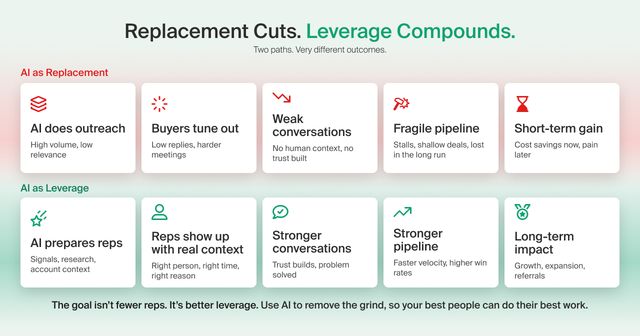
In a replacement model, AI handles the outreach and the rep handles the exceptions.
The rep is downstream of the system, cleaning up what the automation couldn't manage.
In a leverage model, AI handles the preparation and the rep handles the conversation.
The rep is upstream of the system, using what the AI surfaced to show up to every interaction already oriented. Already knowing what's happening at the account. Already knowing what changed, who matters, and why now is or isn't the right moment.
The output looks similar from the outside. Both models produce outreach. Both models generate pipeline activity. The difference is in what happens when a buyer responds. In the replacement model, the rep who picks up is starting from scratch. In the leverage model, the rep who picks up already knows the account well enough to have a real conversation.
That's the conversation that closes deals. And it requires a human who was prepared well enough to have it.
The sales leader's actual job in an AI GTM world
If you're a VP of Sales or a CRO being asked to operationalize AI, the pressure is usually framed around efficiency. How do we do more with less? How do we scale without adding headcount? How do we show the board that the AI investment is producing results?
Those are real questions. The problem is that "do more with less" is a direction, not a strategy. Pointed at the wrong thing, it produces a leaner team doing lower-quality work at higher volume. Pointed at the right thing, it produces the same team doing meaningfully better work because the system is finally handling everything that was getting in their way.
The right thing to automate is the mechanical work. The research. The data hygiene. The signal monitoring. The list building. The first-draft personalization. All of it automatable. None of it requiring the judgment, the relationship instinct, or the human presence that makes a sales conversation worth having.
When AI handles those jobs, the rep gets something back that the modern GTM stack has been slowly taking away: time to actually sell. Time to build the kind of account knowledge that makes a discovery call feel like a conversation instead of a script. Time to follow up not because an automation triggered a task but because they know the account well enough to know this is the right moment.
That's what AI as leverage produces: a team that operates above the level the old system was forcing them to work at.
Why this matters more than it looks like it does
The companies building leverage models right now are accumulating an advantage that's going to be hard to close in 18 months.
It's not a technology advantage. Everyone has access to roughly the same AI tools. It's a human advantage. They have reps who are getting better at selling because the system is doing the mechanical work and leaving them the judgment work. They have relationships with buyers that were built by actual humans who showed up prepared and stayed engaged. They have pipeline that's grounded in real conversations rather than automated sequences that happened to convert.
The companies running replacement models are accumulating a different kind of compound effect. Their reps are getting worse at the things AI can't do, because they're not being asked to do them. Their buyer relationships are thinner, because they were largely handled by a system. Their pipeline is more fragile, because it was built on volume rather than trust.
Neither of these shows up clearly in a quarterly review. Both of them show up clearly in a three-year revenue trajectory.
The sales leaders making the right call right now aren't the ones who figured out how to automate the most. They're the ones who figured out what to automate and what to leave human, and built a system that makes both better.
Building the leverage model with Common Room
Common Room is built on a specific belief: AI should increase human capacity, not replace it.
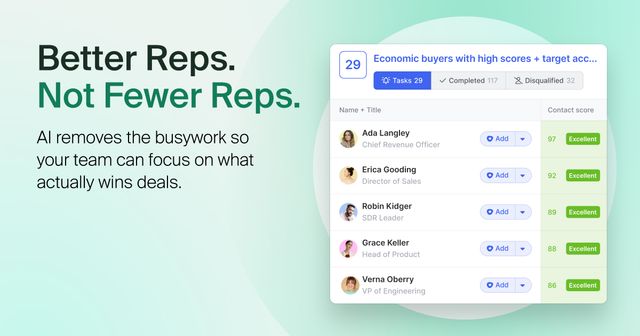
That belief shows up in how the platform is designed. Research agents that surface account and contact context before a rep ever opens a compose window, so the rep starts every conversation already oriented. Personalization agents that do the synthesis work so the rep can do the refinement work. Data hygiene agents that keep the foundation clean so the signals the rep is working from actually reflect reality.
What Common Room doesn't do is try to remove the rep from the motion. The rep is the point. The agent stack exists to make the rep better at being the point.
The result is a team that works the same hours and has meaningfully better conversations. Not because AI is doing the selling. Because AI handled everything that was getting in the way of selling, and left the rep the part that actually requires a human.
That's the model Common Room is built on: one where AI does the busywork and the rep does the job that was always actually theirs. Your best reps are about to look even better. The ones who were coasting on activity are about to have a much harder time explaining why their number is dropping.
Common Room is the AI-native GTM platform that turns complete and trusted buyer intelligence into action. Built on the belief that AI should increase human leverage, not replace human judgment.